What Your OB Won't Tell You About Tearing
A Doctor of Physical Therapy's simple, at-home method to help prepare your body for birth without fear, shame, or guesswork.
The evidence-backed guide that shows you exactly how to prepare your tissues for birth in 10 minutes a day even if no one has ever taught you how.
If the thought of tearing has ever kept you up at 2am scrolling your phone… you're not alone. And you're not overreacting.
Somewhere around week 30, it hits you.
You start Googling things like "perineal tearing prevention" and "does perineal massage actually work" — and you fall down a rabbit hole of horror stories, conflicting advice, and vague reassurances from your OB that boil down to:
"Your body will just know what to do."
But that doesn't feel like enough. Not when it's your body. Not when it's your recovery. Not when the stakes feel this high.
Here's what nobody tells you at your 10-minute prenatal appointment:
Tearing isn't just "bad luck", it's influenced by things you can actually prepare for
Your OB is trained to catch and repair, not to help you prevent
"Just do your Kegels" is not a birth prep plan
Most women find out about perineal massage from a mom group at 38 weeks, when it's almost too late to start
You deserve more than a shrug and a pamphlet. You deserve a real plan, backed by real evidence, from someone who actually specializes in this part of your body.
“I feel like most people teach stretching your pelvic floor in one direction which is what I was doing. Your guide actually helped get rid of my pubic symphysis pain after stretching!”
— Amanda, First Time Mom
Now imagine walking into your birth knowing exactly how to prepare your tissues for what's ahead.
Imagine feeling confident instead of afraid every time someone mentions "tearing" or "episiotomy."
Imagine having a simple, private, 10-minute nightly practice — one backed by research, not Pinterest — that helps your body meet the stretch of birth instead of bracing against it.
Here's what becomes possible when you actually know what to do:
✔️ You stop spiraling every time a birth story mentions stitches
✔️ You feel like an active participant in your own birth prep, not a passenger
✔️ You walk into your birth room with a body that has practiced this before
✔️ You know what questions to ask your provider and what your options actually are
✔️ You feel less afraid, and more prepared, with every week that passes
And not only is this possible, I put together a simple, step-by-step guide to help you do exactly this.
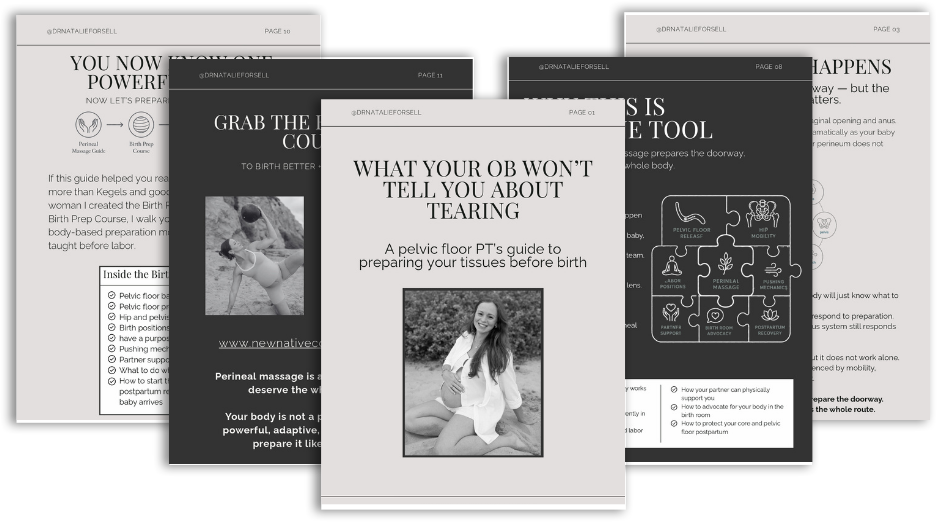
What Your OB Won't Tell You About Tearing
A pelvic floor PT's guide to preparing your tissues before birth
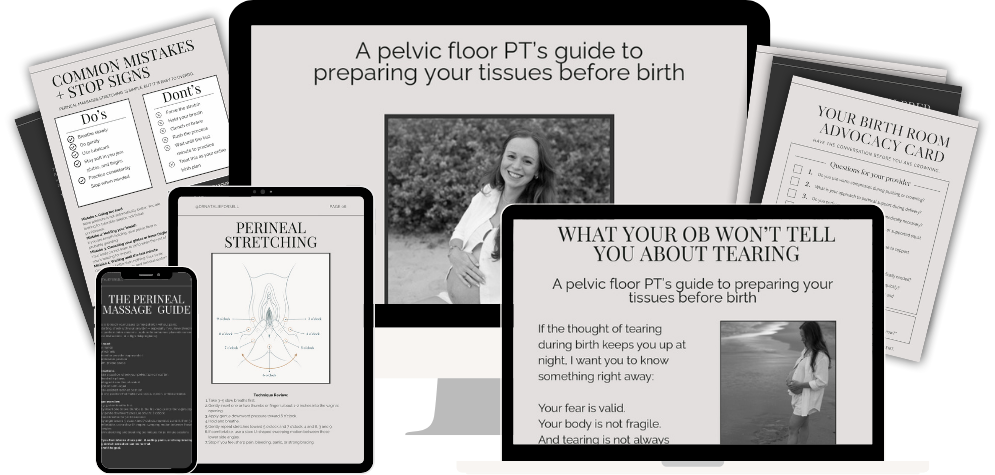
An 11-page, easy-to-follow digital guide that teaches you the why behind tearing, the exact evidence-based perineal massage and stretching technique to prepare your tissues, the common mistakes to avoid, and the exact questions to ask your provider before you're ever in the room crowning.
LIMITED OFFER: $27!!
What makes this different from the "just Google it" version?
Because let's be honest — perineal massage tutorials are everywhere online. So why pay $27 for this one?
✔️ It's written by a Doctor of Physical Therapy who specializes in pelvic floor health; not a wellness influencer repeating what she read somewhere else
✔️ It's evidence-based, not fear-based. You'll learn what the actual research says (including real numbers), and what it doesn't say, no exaggerated promises
✔️ It teaches the whole system, not just the technique. Most tutorials show you where to press. This guide teaches you why your pelvic floor, hips, breath, and nervous system all matter too
✔️ It includes a Birth Room Advocacy Card — the exact questions to ask your provider so you're not having this conversation for the first time while you're in labor
✔️ It's designed for the anxious first-time mom, not the person who already feels calm about birth because you deserve a resource that meets you where you actually are
I'm so glad I found this guide. Why don't our doctors know about this or talk about it more?!
— Kelly, Mom of 2GRAB THE GUIDE**
GRAB THE GUIDE**

By the end of this guide, you'll know how to:
This guide will teach you how to:
Understand exactly why tearing happens — and why it's not just "bad luck" — so you can stop spiraling and start preparing
Perform the evidence-supported perineal massage & stretching technique, step by step, so your tissues learn to meet stretch instead of panic
Recognize the common mistakes that make perineal prep less effective (and even counterproductive) so you don't waste your effort
Know exactly when to stop and call your provider, so you can practice safely and confidently
Walk into your prenatal appointments with the right questions, so your provider knows exactly how you want to be supported during crowning
Understand where perineal massage fits into your bigger birth prep picture so you're not relying on one tool and hoping for the best
Here's exactly what's inside:
Why Tearing Happens The real explanation of what influences your perineum during birth (pelvic floor, hips, pelvis, breath, birth position, pushing, and provider support), so you finally understand the full picture instead of one scary word.
What the Research Actually Says A clear, honest breakdown of the perineal massage research (including the actual data), plus what it does not replace so you go in with realistic, confident expectations.
The Perineal Massage & Stretching Guide A full step-by-step walkthrough: what you'll need, safe positioning options, and the exact technique — clock positions, pressure, breath — explained simply enough to follow tonight.
Visual Perineal Stretching Diagram An easy-to-follow illustrated guide so you're never second-guessing whether you're doing it "right."
Common Mistakes + Stop Signs The Do's and Don'ts that most guides skip, plus a clear list of symptoms that mean it's time to stop and check in with your provider.
Your Birth Room Advocacy Card A printable/screenshot-ready list of 9 questions to ask your provider, plus a partner script, so this conversation happens before you're crowning, not during.
Get instant access for just $27
When you think about what's normally involved in birth prep — labor classes, doulas, specialty appointments — a clear, doctor-written guide for less than the cost of your prenatal vitamins is one of the easiest decisions you'll make this trimester.
Meet Dr. Natalie Forsell, your pelvic floor PT and new native coach.


Hi, I'm Natalie. I'm a Doctor of Physical Therapy specializing in pelvic floor health, and I help pregnant and postpartum women understand what's actually happening in their bodies instead of being handed a pamphlet and sent on their way.
I created this guide because I kept hearing the same story from moms in my practice: "No one told me I could prepare for this." Not their OB. Not their childbirth class. No one.
Your body is not fragile, and it's not something you just have to hope works out. It can be prepared gently, safely, and with real information behind it.
That's what I want for you.
Here's why you shouldn't wait until "later" to start.
If you've made it this far, you already know something important: birth prep isn't just a hospital bag and a playlist.
The research on perineal massage specifically points to starting in the third trimester for it to be most effective. This means the sooner you start, the more time your tissues and nervous system have to actually practice and respond.
Every week you wait is a week your body doesn't get to prepare. With this guide, you just need 10 minutes, a few nights a week, and a clear plan, which is exactly what's waiting for you inside.
Questions other moms asked before saying yes
-
No and you should be wary of anyone who promises that. What the research shows is that perineal massage can help reduce the severity of tearing for many women. This guide gives you an evidence-based tool and a realistic understanding of what it can and can't do.
-
For most low-risk pregnancies, yes. The guide walks you through exactly how to do it safely, plus a clear list of symptoms that mean you should stop and check with your provider first. If you have any pregnancy complications, we recommend checking with your provider before starting, the guide tells you exactly which situations to flag.
-
The guide is designed for anyone in the third trimester, though you can read the education sections anytime. Starting around 34–36 weeks is common, but around 32 weeks is genuinely better, your tissues and nervous system benefit from more practice time, not less.
-
This guide was written specifically with first-time moms in mind. No prior pelvic floor knowledge needed.
-
It's an instant-download digital PDF guide. As soon as you check out, you'll get access to download and save it to your phone or computer; no waiting, no shipping.